
Between Spartanburg and Greenville
Barndominium Builders in Duncan, SC
An I-85 town with a river on its northern edge and industry all around.
- Free on-site land and build estimates
- Written, line-item pricing before work starts
- County permit and septic research included
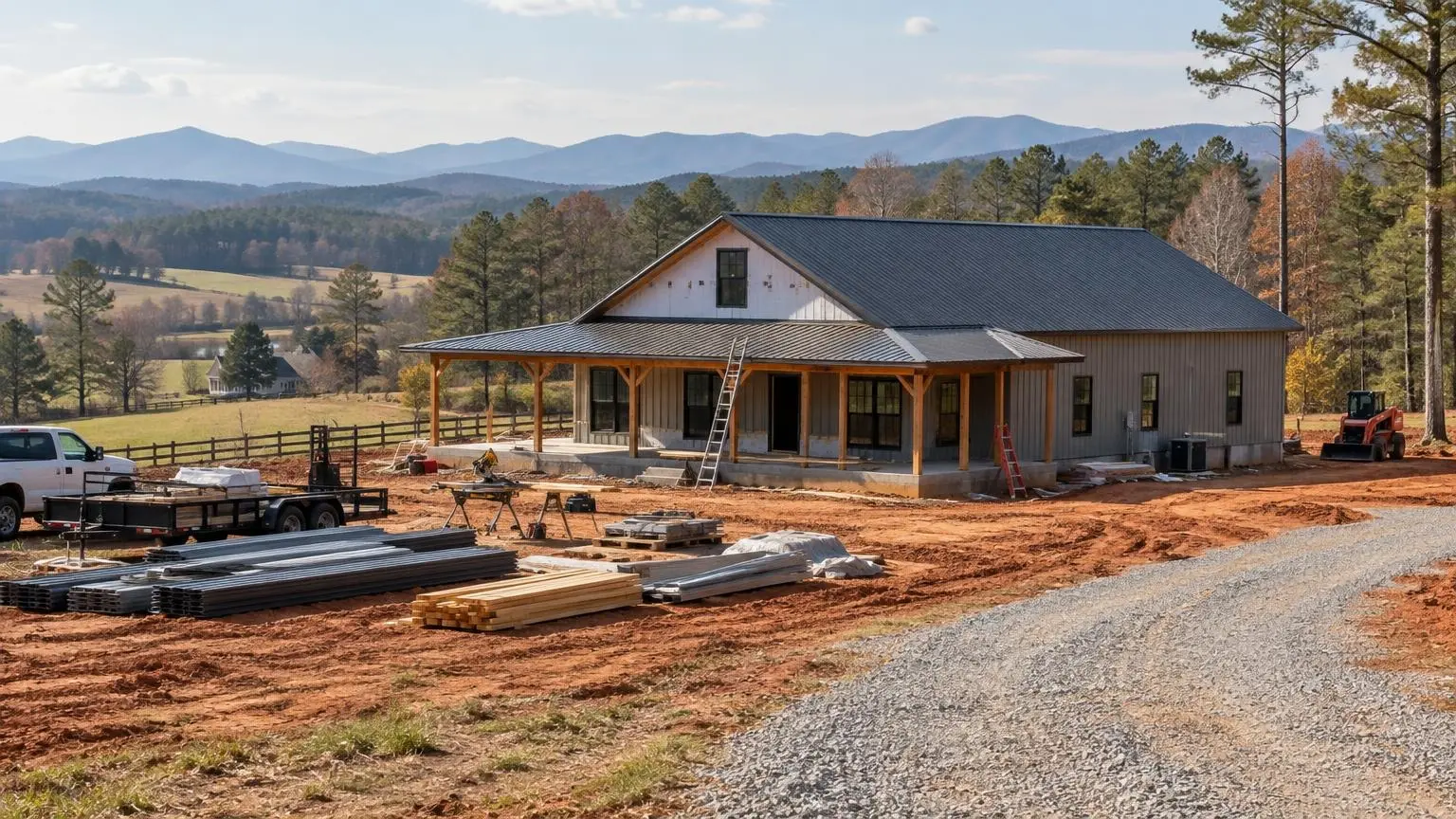
Barndominium Builders Who Plan Around the River
Barndominium builders in Duncan spend as much time on the map as on the slab. Duncan sits west of Spartanburg and east of Greenville, centered on the junction of SC 290 and SC 292, and its town limits run south to Interstate 85 and north beyond U.S. 29. The Middle Tyger River passes through the northern part of town and forms part of the boundary with Lyman. That river is the main reason a Duncan site plan starts with a flood map.
A town that keeps growing
Duncan counted 3,181 people in 2010 and 4,041 in 2020. The town's location along I-85 has drawn international employers: the North American headquarters of Staubli, Rochling Group and Draxlmaier Group are in Duncan. For a barndominium buyer, that employment base is a reason the area stays busy, and it is worth checking what is planned near any parcel you consider.
Floodplain first
Land along the Middle Tyger and its creeks can include mapped floodplain. Spartanburg County handles floodplain matters through its Engineering and Flood Plains office, which offers a floodplain development application and permit, floodplain verification, and Letter of Map Amendment (out as shown) paperwork, along with links to the FEMA floodplain maps. For a barndominium that means:
- We check the FEMA map and the county GIS before choosing a building pad.
- If any part of the work falls in the floodplain, a floodplain development permit comes before the building permit.
- If the structure sits on high ground that the map shows as floodplain, a Letter of Map Amendment may be worth pursuing.
Bottomland soils also behave differently. The USDA's Chewacla series, a flood plain soil found across the Carolinas and Georgia, is somewhat poorly drained, has a seasonal high water table 6 to 24 inches down from November to April, and floods anywhere from rarely to frequently. Ground like that is fine for pasture but is a poor place for a slab or a drainfield. We keep the house and septic on the higher ground.
Who permits a Duncan barndominium
Inside town limits, the Town of Duncan's requirements apply, so start there. On county land around Duncan, Spartanburg County Building Codes reviews plans, issues permits and inspects. Applications go through the county's Citizen Self Service portal, and Planning, Engineering and Building Codes approvals can run at the same time. The county works from the 2021 International One and Two Family Dwelling Code, the 2020 National Electrical Code and the 2009 International Energy Code. Once the final inspection passes, the certificate of occupancy shows up as an attachment in the portal.
Land use is lighter than many buyers expect. The county runs the Performance Zoning Ordinance in its Southwest Planning Area and the Unified Land Management Ordinance elsewhere, and neither assigns parcel-level zoning classifications. Design standards apply to non-residential buildings on arterial and collector streets, which is worth knowing if your shop will host a business.
Septic on the uplands
Lots away from town sewer need a septic permit from the state's septic program at the SC Department of Environmental Services. The evaluator looks at soil and landscape position, so the same upland ridges that keep a slab dry are usually where the drainfield goes too. Plan the house, shop, driveway and drainfield together.
Heat and humidity
Greenville, a short drive west, averages about 43 days a year at or above 90 degrees F and about 59 nights at or below freezing, and its records note that ice storms and sleet are more common there than heavy snow. A metal building in that climate needs a real plan for condensation: a vapor barrier under the slab, insulation that keeps warm, moist air off cold steel, ventilation, and HVAC sized to remove moisture as well as heat.
History you can still see
Duncan began as New Hope, with a post office established in 1811. It was renamed Vernonsville in 1854, the railroad arrived in 1873, the name became Duncan in 1881 after Leroy Duncan, and the town received its charter in 1889. The older blocks around Main Street (SC 290) reflect that railroad-era layout, with small lots close together. The larger parcels outside the core suit a barndominium better.
Call (864) 326-0632 or
to set up a visit to your Duncan land.Duncan Site Notes
- Middle Tyger River. The river passes through northern Duncan and forms part of the boundary with Lyman.
- Floodplain permits. Spartanburg County Engineering offers floodplain development permits, floodplain verification and Letter of Map Amendment forms.
- Growth. Duncan grew from 3,181 residents in 2010 to 4,041 in 2020.
- Bottomland soil. The USDA's Chewacla flood plain series has a seasonal high water table 6 to 24 inches deep from November to April.
- I-85 corridor. Town limits extend south to I-85 and north beyond US 29; Staubli, Rochling and Draxlmaier have North American headquarters here.
Duncan Questions
Is my Duncan land in a flood zone?
Parcels near the Middle Tyger River and its creeks can be. We check the FEMA map and Spartanburg County GIS, and if work touches the floodplain, the county's floodplain development permit comes first.
What if the map shows floodplain but my building site is high?
Spartanburg County Engineering handles Letter of Map Amendment paperwork. If the pad is truly above the flood elevation, a LOMA can be worth pursuing.
Do I need a separate permit for a shop with living quarters?
A shop house is permitted as a residence, with separate building, electrical and plumbing permits in Spartanburg County. A business use on a main road may bring design standards into play.
Can a septic system go in the low part of the lot?
Usually not. Bottomland soils like Chewacla stay wet much of the year. Drainfields generally go on the drier upland ground.
Barndominium Builders Near Duncan
- Barndominium Builders in Greenville, SC
- Barndominium Builders in Greer, SC
- Barndominium Builders in Simpsonville, SC
- Barndominium Builders in Mauldin, SC
- Barndominium Builders in Fountain Inn, SC
- Barndominium Builders in Travelers Rest, SC
- Barndominium Builders in Easley, SC
- Barndominium Builders in Pickens, SC
- Barndominium Builders in Liberty, SC
- Barndominium Builders in Piedmont, SC
- Barndominium Builders in Powdersville, SC
- Barndominium Builders in Anderson, SC
- Barndominium Builders in Belton, SC
- Barndominium Builders in Williamston, SC
- Barndominium Builders in Honea Path, SC
- Barndominium Builders in Spartanburg, SC
- Barndominium Builders in Boiling Springs, SC
- Barndominium Builders in Inman, SC
- Barndominium Builders in Lyman, SC
- Barndominium Builders in Landrum, SC
- Barndominium Builders in Laurens, SC
- Barndominium Builders in Seneca, SC
- Barndominium Builders in Clemson, SC